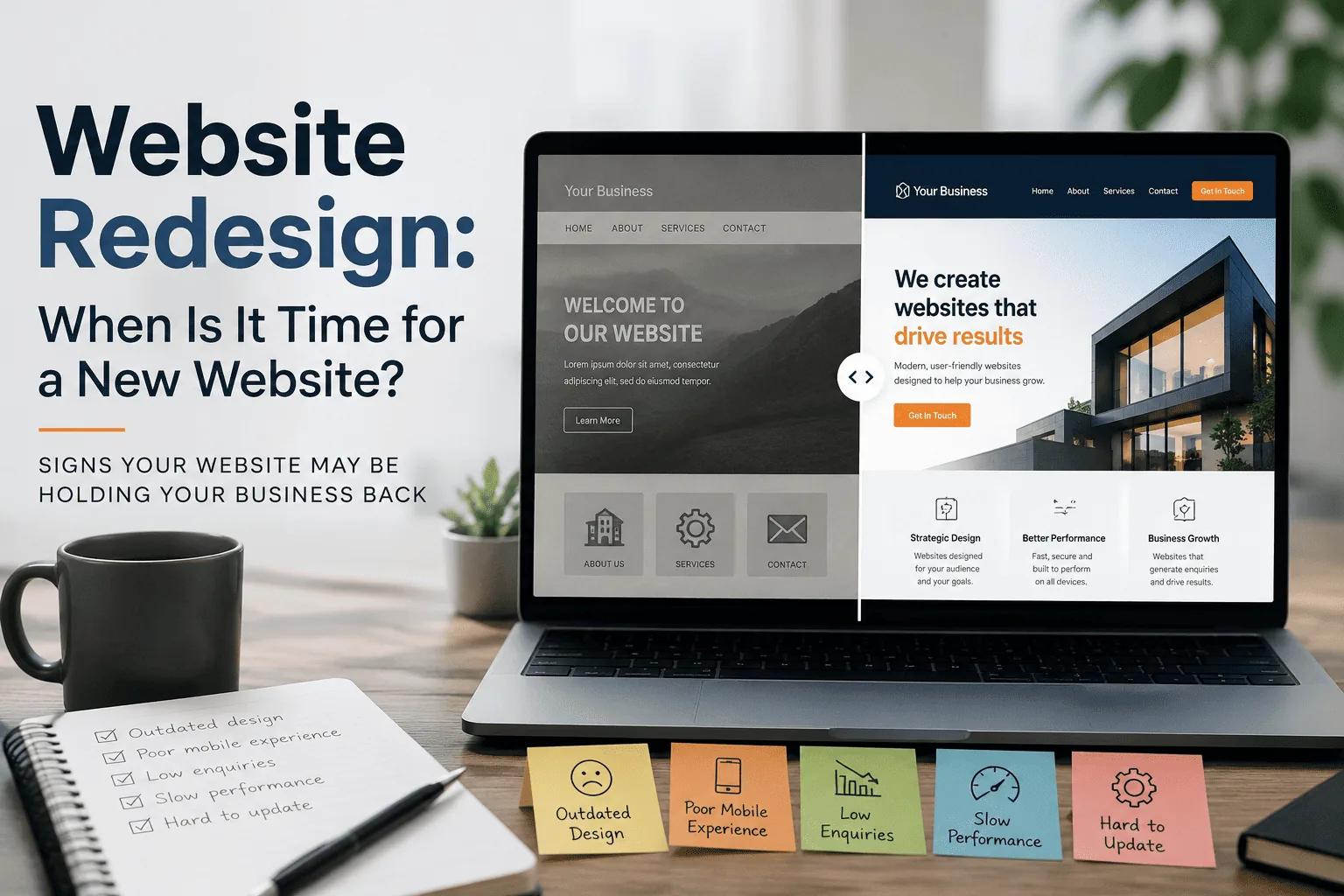
Website Redesign: When Is It Time for a New Website?
Your website probably isn't something you think about every day. Once it's live, it tends to become part of the furniture. You update the odd page, add a blog post now and then, change a team member's photo when someone leaves, and otherwise leave it alone. And that's perfectly reasonable. You have a business to run.
The problem is that businesses change much faster than websites do. The site that worked perfectly well when you launched might now be making it harder for customers to understand what you offer, harder for your team to manage, and harder for you to generate enquiries. It might even be costing you opportunities without you realising it.
So, when should you redesign your website? There isn't a magic age at which a website suddenly becomes "too old". Five years isn't automatically bad, and a two-year-old website isn't automatically good. What matters is whether your website is still doing its job. Here are the signs that it might be time for a website redesign.
TL;DR
- There is no set age at which a website needs to be redesigned. The important question is whether it still supports your business and its goals.
- If your business has changed, your website looks outdated, is difficult to use or no longer reflects your brand, it may be time for a redesign.
- Poor conversions, slow performance, weak mobile usability and SEO limitations are also signs that your current website may be holding you back.
- If your team is constantly dealing with workarounds, technical problems or a difficult content management process, the underlying website may no longer be suitable for your needs.
- A website redesign does not always mean a complete rebuild. The right approach depends on whether the problems are with the design and user experience or with the underlying technology.
- Ultimately, the best time to redesign your website is when the current site is starting to get in the way of where your business is going.
1. Your business has changed, but your website hasn't
This is probably one of the clearest signs. Businesses evolve. You add services, change your positioning, move into new markets, target different customers or simply become a much larger company than you were when the website was first created.
Your website needs to reflect that. Imagine a professional services company that started out offering three straightforward services. Five years later, it has expanded into consulting, implementation and ongoing support, but the website still presents the business exactly as it did when it launched.
The problem isn't necessarily that the design looks old. The problem is that the website no longer tells the right story. Real estate businesses are a good example. An estate agency might start as a small local team focused purely on residential sales. A few years later, it could have expanded into lettings, property management, commercial property or new developments.
If the website still looks like a small sales agency, potential clients may not realise what the business has become. A website redesign gives you an opportunity to bring the website back in line with the business it represents.
2. Your website looks like it belongs to another era
Let's be honest. Sometimes you can tell immediately when a website hasn't been touched in years. Perhaps the homepage is packed with tiny text. The navigation is confusing. The images look dated. The design doesn't work particularly well on mobile. Or the whole thing simply feels like it was built when everyone was still using Internet Explorer.
A dated appearance isn't just an aesthetic problem. People make judgements about businesses based on their online presence. If your website looks neglected, visitors can reasonably wonder whether the business itself is equally behind the times.
That doesn't mean you need to redesign your website every time a new design trend appears. In fact, chasing trends is a good way to end up redesigning it again in two years. The goal is a professional, useful and modern experience that supports your brand.
3. Your website isn't generating enough enquiries
A website can look fantastic and still be terrible at generating business. If visitors are arriving but very few are contacting you, booking a call, requesting a quote or taking whatever action matters to your business, something needs investigating.
Don't immediately assume the answer is a complete redesign. There could be problems with your traffic, offer, messaging, landing pages or conversion tracking. But if the website makes it difficult for people to take the next step, redesigning the experience can make a significant difference.
Think about a typical visitor. They arrive on your homepage, understand what you do, decide they're interested and then... what? Is the next step obvious?
Real estate websites have plenty of potential conversion points. A visitor might want to book a valuation, request a viewing, contact an agent or enquire about a property. If those actions are buried in the footer or hidden behind confusing navigation, you're making the visitor work unnecessarily hard.
Good website redesign for better conversions isn't about adding a giant "CONTACT US" button to every section. It's about understanding what visitors want to do and making those actions feel natural.
4. Your website is difficult to use
You know your website inside out. Your customers don't. That distinction matters. You know exactly where to find your services, contact details or pricing because you've looked at the site hundreds of times. A first-time visitor doesn't have that advantage.
If people regularly struggle to find information, your navigation is probably doing too much work. If they have to click through five pages to reach something important, there may be a simpler way to structure the site.
This is one of the most useful things to look for when redesigning a website: don't just ask whether each page looks good. Ask whether the entire journey makes sense. The design might be perfectly attractive. The user experience isn't.
5. Your website is painfully slow
Nobody enjoys waiting for a website to load. A slow website can affect the user experience, conversions and how effectively your site performs in search. There are plenty of reasons a site can become sluggish over time, including large images, excessive scripts, poorly implemented functionality and third-party tools.
Sometimes you can fix these issues without a complete redesign. But if performance problems are symptoms of an outdated technical foundation, a website redesign may be the sensible opportunity to address them properly rather than continually patching the same problems.
This is particularly relevant if the website has grown through years of additions. One plugin became five. A tracking script was added here. Another integration appeared there. Suddenly the website has accumulated years of technical baggage. At some point, starting with a cleaner foundation can make more sense than endlessly fixing the old one.
6. Your website doesn't work properly on mobile
This one should be fairly obvious, but it's still worth checking. People browse websites on phones constantly. If your website technically works on mobile but feels awkward to use, that's not much better than it not working at all.
Look at your own website on a phone and try to complete the things you expect customers to do. Can you find the important information quickly? Are buttons easy to tap? Do images display properly? Is the text comfortable to read? Can you complete a form without wanting to throw the phone across the room?
For a real estate website, mobile usability is even more noticeable because property browsing is often highly visual. If someone is scrolling through listings on their phone and the gallery is clunky, filters are difficult to use or important property information is buried, they may simply move on to another agency.
7. Your website is holding back your SEO
A redesign should not mean starting your SEO from scratch. In fact, one of the biggest mistakes businesses can make is treating website redesign SEO as an afterthought. A new design can look brilliant while accidentally creating a mess of URLs, redirects, metadata, internal links and indexed pages.
The better approach is to consider SEO as part of the redesign process from the beginning. Your existing website may already have pages that rank, attract backlinks or generate organic traffic. Those assets need to be understood before anything is removed or changed.
There may also be technical limitations in the current site that make SEO harder than it needs to be. A growing real estate business, for example, might eventually want dedicated pages for towns, neighbourhoods, property types, market guides and useful buying information. If the existing website wasn't built with that kind of content structure in mind, expansion can become awkward.
8. You've started adding workarounds everywhere
This is one of those signs you tend to notice gradually. First, you add a plugin. Then another. Then you discover that the plugin doesn't quite do what you need, so you add another tool to fill the gap.
Workarounds aren't inherently bad. Every website has them to some degree. But if your team is constantly finding ways around limitations in the platform or existing design, your website may no longer be suitable for the business. At that point, the question isn't simply, "Can we make this work?" It's, "Is this still the right foundation for what we're trying to achieve?" If you're constantly working around the limitations of a website builder, it may be worth considering whether a custom website would be a better fit.
9. Your team hates using the website
Your customers aren't the only people who use your website. Your own team does too. If updating a page takes three people, adding a new service is unnecessarily complicated, or publishing content feels like a chore, the website is creating friction internally. And internal friction has a habit of becoming external friction.
If your marketing team avoids updating the website because it's difficult, your content becomes stale. If your sales team can't quickly direct prospects to useful information, opportunities are missed. If property listings require a cumbersome manual process, your team wastes time doing something the website should make easier. A website should support the people running the business, not constantly ask them to work around it.
Website redesign vs rebuild: are they the same thing?
Not necessarily. A website redesign usually focuses on improving the website's visual design, user experience, structure and functionality while retaining some of the underlying foundation.
A rebuild goes deeper. The site may be redeveloped using a different technology, architecture or CMS, particularly when the existing system has become a limitation. The distinction matters because you don't necessarily need a completely new technical platform just because your website needs a refresh.
On the other hand, if you're dealing with years of technical problems, poor performance, inflexible functionality and a platform that can't support where the business is heading, putting a new coat of paint over the old foundation probably isn't the answer.
The right website redesign process starts by figuring out which problem you're actually trying to solve.
So, how often should you redesign a website?
This is one of those questions where the internet loves giving you a nice, simple number. Three years. Five years. Seven years. The reality is less convenient. There is no universal schedule for when to redesign your website.
A small business with a straightforward website might be perfectly happy for several years. A rapidly growing company with changing requirements could need major changes much sooner. Instead of asking, "How old is our website?", ask:
- Does it still reflect our business?
- Is it easy for customers to use?
- Is it generating the results we need?
- Can we update and manage it efficiently?
- Does it support our SEO strategy?
- Can it handle what we want to do next?
If most of those answers are no, the age of the website becomes almost irrelevant.
What does a website redesign cost?
Website redesign cost varies enormously depending on what actually needs changing. A relatively simple project might involve a visual refresh, improved navigation and updated content. A larger website redesign project could involve new functionality, integrations, a new CMS, custom development, SEO migration and a completely different user experience.
That's why comparing redesign prices without comparing scope can be misleading. Two businesses might both want a website redesign, while one is essentially refreshing ten pages and the other is rebuilding a complex property platform with CRM integrations.
The question should not just be "How much does it cost?" but instead "What do we need the new website to achieve, and what will it take to build it properly?" That shifts the conversation away from buying a prettier website and towards investing in a digital asset that actually supports the business.
When a new website starts to make sense (Conclusion)
The biggest sign that you need a website redesign isn't that your website is old. It's that your website is starting to get in the way. Perhaps the current site doesn't convert. Maybe customers can't find what they need. Perhaps your business has changed significantly, your SEO strategy has outgrown the existing structure, or the technology is preventing you from adding functionality.
That's when redesigning a website becomes less about changing colours and moving buttons around, and more about creating a website that actually fits the business where it is now. The strongest redesigns are driven by business problems. A redesign should solve something.
And if the existing website is still performing well, represents the brand accurately and gives customers a good experience, there may be no urgent reason to replace it. Sometimes a few targeted improvements are all you need.
Is Your Website Holding Your Business Back?
If your website no longer reflects your business, is difficult to manage, or is getting in the way of your marketing, it may be time for a change. The Code Bottega creates custom websites focused on your business goals, your customers and what you need your website to achieve. Get in touch today and let's talk about what your website needs to better support your business and where you want to take it next.
Frequently Asked Questions
How often should a business review its website?
It's a good idea to regularly review whether your website still reflects your business, performs well and supports your goals. A review does not necessarily mean you need a full redesign, but it can help identify problems before they start affecting your customers and marketing.
Can a website redesign improve conversions?
It can. Improving navigation, messaging, page structure, calls to action and the overall user experience can make it easier for visitors to take the actions that matter to your business.
Will redesigning my website affect my SEO?
It can if the redesign is not handled carefully. Changes to URLs, page structure, content and internal links can affect search visibility, so SEO should be considered throughout the redesign rather than after the new website is launched.
How long does a website redesign take?
There is no fixed timeframe because it depends on the size and complexity of the website, the amount of content involved and whether the project includes new functionality or development work.
Is it worth paying a professional to redesign a website?
For businesses that rely on their website to generate enquiries or support sales, a professional redesign can be a worthwhile investment. A good redesign should address the underlying problems with the existing website rather than simply giving it a new visual appearance.
What should I look for when choosing a website redesign company?
Look beyond the visual quality of their portfolio. Consider their experience with businesses similar to yours, their approach to SEO and performance, how they handle existing content and URLs, and whether they can support the technical requirements of your new website.
Should I hire a web designer or a web development agency for a redesign?
It depends on the complexity of the project. A web designer may be suitable for a primarily visual refresh, while an agency with both design and development capabilities can be a better fit if the project involves custom functionality, integrations, SEO or changes to the underlying technology. If you're unsure which approach is right for your website, get in touch with The Code Bottega and we can discuss what your project requires.