How Much Does Website Design Cost in the UK? What to Budget For
If you've started looking into a new website, you've probably noticed something slightly frustrating: website design prices seem to be all over the place. One company might quote £1,500. Another might want £6,000. Someone else might tell you that a website could cost £20,000 or more. So, how much does website design actually cost in the UK?
The short answer is that there isn't one price because there isn't one type of website. A five-page site for a small local business is a very different project from a bespoke website with integrations, advanced functionality and a serious SEO strategy.
Current UK pricing data put simple freelancer-built sites roughly in the low thousands, while professional agency projects commonly move into the £3,000 to £10,000+ range. More complex bespoke websites can go considerably higher. The useful question, then, isn't simply "How much does a website cost?" It's "What should I budget for the website my business actually needs?"
TL;DR
- Website design costs vary depending on the size, complexity and functionality of the project.
- For a professional business website in the UK, a realistic starting point is usually somewhere in the low thousands, while custom or more complex projects can reach £10,000+ and sometimes much higher.
- DIY website builders are usually the cheapest option, while freelancers, studios and agencies offer increasing levels of customisation and support.
- Custom websites generally cost more because they require more planning, design, development and functionality.
- When comparing website quotes, look at what is included rather than simply choosing the lowest price.
- Remember to budget for costs outside the initial build, such as hosting, maintenance, content and SEO.
- Real estate websites can cost more when they require property feeds, CRM integrations, advanced search or other custom functionality.
- The right budget depends on what you need the website to achieve, not simply how many pages you want.
What actually affects website design cost?
The number of pages is one factor, but it's far from the whole story. A website with ten fairly straightforward pages can cost less than a five-page website that requires custom functionality, integrations and carefully planned user journeys. The amount of work involved behind each page matters just as much as the page count.
Design is another major factor. There's a considerable difference between taking an existing template and adapting it to your brand, and creating a bespoke visual identity and user experience specifically for your business.
Then there's development. A standard contact form is relatively simple. Connecting your website to a CRM, booking system, property management platform or another third-party service is a different proposition altogether.
Content can affect the cost too. If you need professional copywriting, photography, illustrations, SEO research or new property imagery, those services may sit outside the core website build. In other words, when comparing website design pricing, don't just ask how many pages you're getting. Ask what work is actually going into those pages.
Website builder, freelancer or agency?
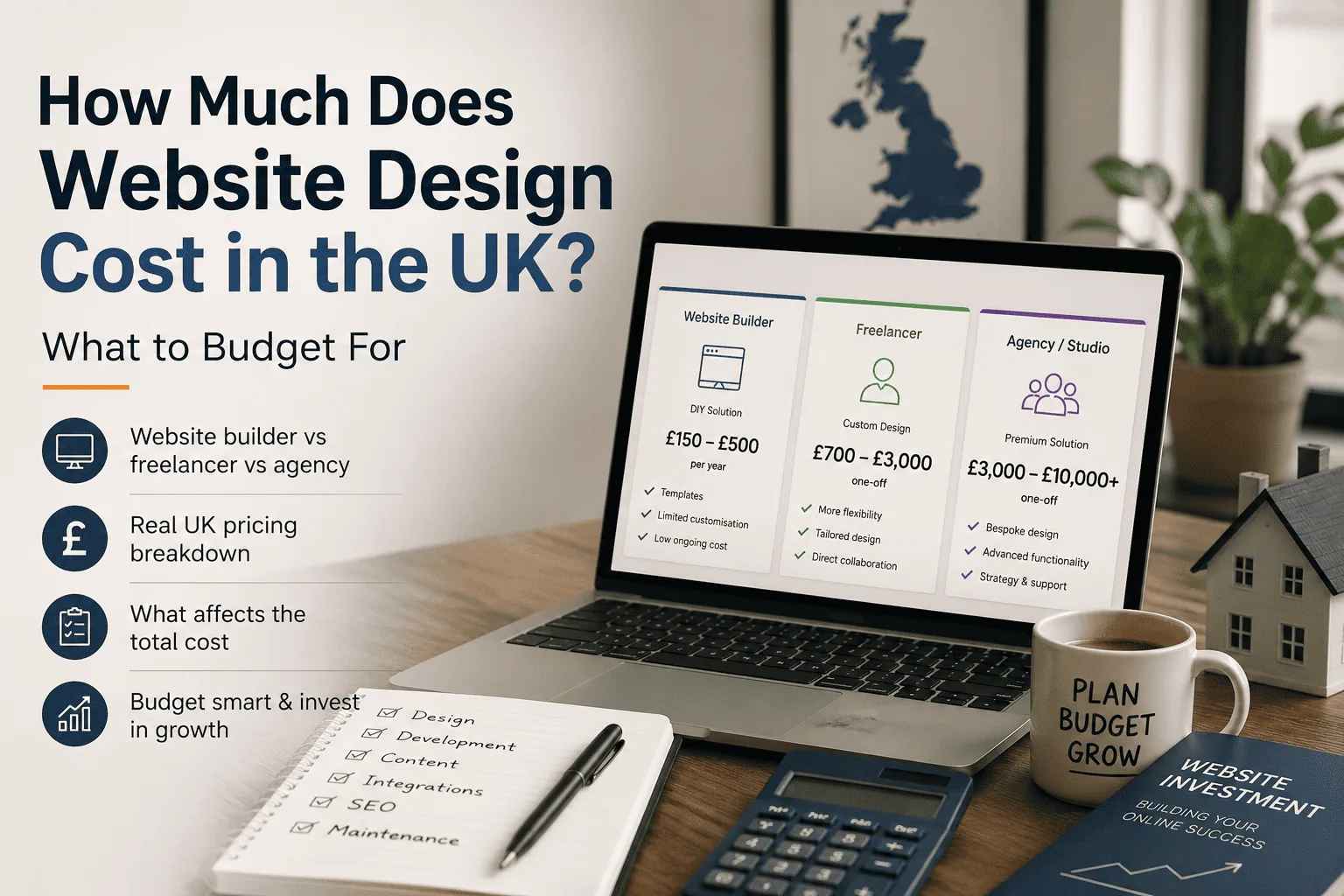
One of the biggest decisions you'll make is who builds the website. A website builder such as Wix or Squarespace can be perfectly sensible for a small business that needs a straightforward online presence. The ongoing platform cost is relatively low, although you're investing your own time instead. Current UK pricing guides put many DIY builder subscriptions in the region of £150 to £500 per year once the basic costs are considered.
A freelancer generally gives you more customisation without the cost of a larger team. For a relatively simple small business website, current UK estimates commonly put freelancer projects somewhere around £700 to £3,000, although the actual figure depends heavily on experience and scope.
Then you have an agency or development studio. You're generally paying more, but you may also be getting strategy, UX, bespoke design, development, SEO considerations, project management and ongoing support from multiple specialists. UK agency pricing varies considerably, but professional projects commonly sit in the £3,000 to £10,000+ range, with more complex builds moving well beyond that.
None of these options is automatically better. A new business with five basic pages doesn't necessarily need a £15,000 website. Likewise, an established company relying heavily on its website shouldn't automatically choose the cheapest option just because it technically "works".
How much does a custom website cost?
This is where website development cost starts to become more difficult to pin down. A custom website doesn't necessarily mean everything has been coded from scratch. It usually means the website has been designed and developed around your business rather than forcing your requirements into a pre-existing template.
For a small to medium-sized business, a genuinely custom website might sit somewhere around £3,000 to £10,000, with more complex projects costing considerably more. Current UK agency pricing guides show a broad range because "custom website" can mean anything from a tailored five-page business site to a large platform with ecommerce, integrations and custom applications.
That's why a bespoke website cost should always be considered alongside the scope. If you're paying £5,000 for a website that simply has a different colour scheme and a few custom sections, you should probably ask some questions. If you're paying £5,000 for a strategically planned website with bespoke design, conversion-focused content, custom functionality and a solid technical foundation, you're looking at a very different project. The price should make sense in relation to what is being built.
What should a professional website actually include?
A professional website should be more than a collection of attractive pages. At a minimum, the project should have a clear purpose. Who is the website for? What do you want those visitors to do? What information do they need before they're willing to contact you?
Good website design considers those questions before anyone starts moving boxes around on a homepage. Depending on the project, most professionally designed websites include:
- A responsive design that works properly across desktop, tablet and mobile.
- A clear site structure and navigation.
- Custom or carefully adapted visual design.
- Content and messaging structured around the target audience.
- Custom functionality and features
- Contact or enquiry functionality.
- Basic technical SEO foundations.
- Performance and usability considerations.
- Analytics and conversion tracking where appropriate.
- A manageable CMS if your team needs to update the site.
Not every project needs every feature. That's the point. The right website should be built around what your business needs, rather than padding out a quote with things you'll never use.
Don't forget the costs outside the website build
The initial quote isn't necessarily the total cost of owning a website. You'll also need a domain and hosting. You may also need ongoing maintenance, security updates, premium plugins or software subscriptions depending on how the website is built.
Then there are services that are often treated separately from website development. Copywriting, professional photography, SEO, branding, ongoing content and paid marketing can all increase your overall investment. Some agencies bundle several of these services into their packages. Others don't. Neither approach is necessarily wrong, but you need to know what you're actually paying for.
This is why a £3,000 website quote isn't automatically cheaper than a £5,000 quote. If the first quote leaves you paying another £2,000 for content, SEO setup and essential functionality, the comparison changes rather quickly.
How much should a real estate business expect to spend?
Real estate websites deserve a little more consideration because the website can become much more than a digital brochure. A small independent estate agency might need a relatively straightforward site with information about its services, property listings, valuation enquiries and contact options. A larger agency might need property feeds, CRM integrations, advanced search, area guides, valuation tools, multiple locations and a much stronger content structure.
That means real estate website cost can vary significantly depending on what the website needs to do. For a smaller agency, a professional real estate website may sit within the same general pricing territory as other established small businesses. Once you start introducing custom integrations, property data, advanced search functionality and a more sophisticated content strategy, the real estate website development project can become considerably more involved.
And this is where a custom real estate website can make sense. If the website is responsible for generating valuation enquiries, property enquiries and organic traffic, you're not simply buying somewhere to display your logo and phone number. You're building part of the infrastructure that supports the business.
When is a cheap website actually expensive?
There's nothing wrong with wanting to keep costs under control. In fact, you should. The problem starts when the cheapest quote becomes the only thing you're comparing.
Imagine a business spends £800 on a website. Six months later, the site needs a major change that the original developer didn't account for. The company discovers that it can't integrate with the software it uses, the SEO structure wasn't considered properly and even simple updates require the developer's involvement. The original website wasn't really £800. It was £800 plus the cost of fixing, replacing or working around it.
This doesn't mean an expensive website is automatically good. Plenty of expensive websites aren't particularly effective either. The lesson is simply that you should consider the total cost of ownership, not just the number on the initial invoice. Several 2026 UK pricing reports make the same point, noting that hosting, maintenance, content and other ongoing requirements can materially change the true cost of a website. Sometimes spending less is the smart decision. Sometimes it creates another problem six months down the line.
How to compare website quotes properly
Getting three quotes is sensible. Comparing them based purely on price isn't. Start by putting the scope of each project next to each other. Are all three companies designing the website from scratch? Are they all providing development? Is copywriting included? What about SEO setup, analytics, hosting and post-launch support?
Pay attention to the process as well. A company that spends time understanding your business, audience and objectives is doing work before the website is even designed. You may not immediately see that work in the finished homepage, but it can have a significant impact on the final result.
It's also worth asking what happens after launch. Can your team update the website? What happens if you stop working with the agency? Are maintenance and support included? A good quote should make these things reasonably clear.
Questions to ask before accepting a web design quote
Before signing anything, ask the agency or developer a few straightforward questions:
1. Exactly what is included in the quoted price?
Ask about design, development, content, SEO, integrations, hosting and revisions.
2. What will I own when the project is finished?
Your business should have a clear understanding of ownership of the website, domain and relevant assets.
3. What happens if we need changes later?
Find out how additional work is charged and what ongoing support looks like.
4. Who is responsible for the content?
A beautifully designed website still needs good words, images and information.
5. What happens after launch?
Ask about maintenance, security, backups, updates and support.
6. What does the website need from us?
This one is often overlooked. You need to know what content, approvals, logins and information you'll be expected to provide.
These questions won't tell you which company to choose. They will, however, make it much easier to understand what you're actually buying.
So, what should you budget for your website?
There isn't a magic number that applies to every business, but the current UK market gives you a useful starting point. A DIY builder can keep your financial cost low, particularly if your requirements are simple. A freelancer can provide a more tailored site for a relatively modest investment. A professional agency or development studio makes more sense when the website is strategically important, technically demanding or expected to become a significant source of enquiries.
For many established small and medium-sized businesses, budgeting somewhere in the low thousands is a realistic starting point. More ambitious custom projects can quickly move into five figures. Current UK pricing guides broadly support that range, although the differences between providers and project scopes are substantial.
The bigger question is what you want the website to do. If the website is simply there so customers can find your phone number, you probably don't need to spend a fortune. If it's expected to generate leads, support SEO, integrate with your systems and represent your business for the next five years, it deserves a different level of investment.
Build the website your business actually needs
Website design cost is easier to understand once you stop treating every website as the same product. A £1,500 website and a £10,000 website aren't necessarily competing versions of the same thing. They may have been designed for completely different businesses, with different objectives, levels of customisation and expectations.
So when you're comparing website design services in the UK, look beyond the headline price. Ask what you're getting, what the website needs to achieve and whether the solution will still make sense as your business grows.
Because ultimately, the cheapest website isn't necessarily the one with the lowest price. It's the one that gives your business what it needs without creating another expensive problem later.
If you're considering a new website or aren't sure what level of investment makes sense for your business, get in touch with The Code Bottega. We can look at what you're trying to achieve and help you work out what kind of website actually makes sense.
Frequently Asked Questions
How do I know how much I should budget for my website?
Start with what you need the website to do rather than choosing a price first. Once you know the required pages, functionality, integrations and level of support, it's much easier to establish a realistic budget.
Are website design costs usually a one-off payment?
The initial website build is usually a project cost, but there can also be ongoing expenses such as hosting, maintenance, software subscriptions and content. Make sure you understand which costs are included in your initial quote and which you'll need to budget for separately.
Do I need to pay for a new website all at once?
Not necessarily. Payment structures vary between web designers and agencies. Some may require a deposit followed by staged payments throughout the project, while others may use a different payment schedule.
Can I reduce the cost of a website by providing my own content?
Potentially. Providing your own copy, images and other assets can reduce the amount of work required from the designer or agency. However, you should make sure the content is suitable for the website and doesn't create additional work later.
Does a more expensive website always mean a better website?
No. Price alone doesn't determine quality. A more expensive website should cost more because it involves more work, functionality, strategy or expertise. The important thing is whether the website is appropriate for your business and what you need it to achieve.